Design & Systems
Information Scent: How People Decide What to Click
Why do users ignore information that's sitting right in front of them? Often, the problem isn't access—it's that the clues leading to it aren't strong enough.

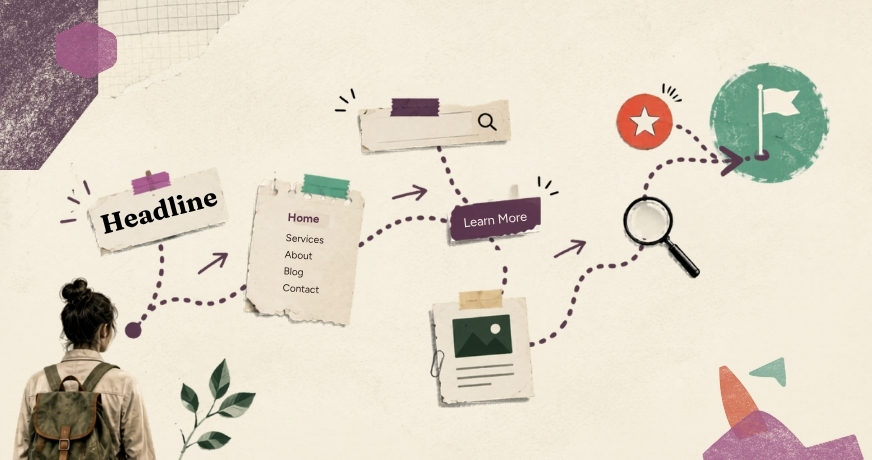
One of the stranger parts of working in user experience is realizing how often people make perfectly reasonable decisions with surprisingly little information.
A page title.
A menu label.
A thumbnail image.
A sentence fragment.
Sometimes that’s all it takes.
Someone glances at a screen for a fraction of a second and decides:
“That looks useful.”
Or:
“Nope. Not what I’m looking for.”
Then they move on.
UX practitioners have a name for this phenomenon. We call it information scent.
The idea is borrowed from nature. Animals follow scents that suggest food, safety, or shelter might be nearby. Humans do something remarkably similar when searching for information.
We follow clues.
Not because we know what’s behind a link.
Because we think we know.
And most of the time, that’s enough.
We rarely evaluate every option
There is a persistent belief that people carefully read websites.
They do not.
At least not at first.
Most of us are scanning.
We skim headlines. We glance at navigation menus. We look for familiar words. We make rapid judgments about whether something appears relevant.
Then we either continue or abandon the trail.
This behaviour isn’t laziness. It’s efficiency.
Imagine standing in your kitchen looking for a dinner recipe.
You don’t usually read every recipe on the internet before choosing one.
You might notice phrases like:
- Easy weeknight dinner
- Slow cooker chicken
- Ready in 30 minutes
One of those catches your attention and you click.
That tiny clue created enough confidence that the next click felt worthwhile.
That’s information scent.

The web is really a series of guesses
When people visit a website, they are constantly making predictions.
If I click this, what will I find?
If I search this term, what will appear?
If I open this menu, will it contain what I need?
Every click is a small act of faith.
The stronger the clues, the stronger the scent.
The weaker the clues, the more likely people are to leave.
This is why websites sometimes fail even when all the information technically exists.
The information is there.
The scent isn’t.
I’ve watched users overlook content that was only one click away because the label didn’t mean anything to them.
I’ve watched them ignore important instructions because they were buried under internal terminology.
I’ve watched people abandon tasks entirely because they couldn’t tell which of three nearly identical options was the right one.
The problem wasn’t access.
The problem was confidence.
What makes a scent strong?
A surprising amount comes down to language.
Words carry baggage.
Every visitor arrives with their own experiences, expectations, and mental models.
An organization might label something according to its internal structure.
A visitor is thinking about a problem they need solved.
Those are not always the same thing.
The strongest information scent usually comes from language that reflects how real people think about the task at hand.
Not how the organization thinks about itself.
This sounds obvious.
It rarely is.
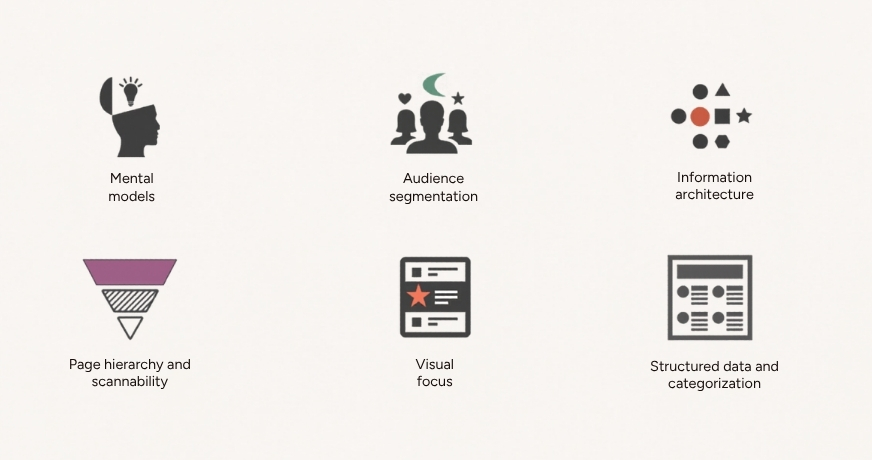
What is considered in
Information Architecture and UX Discovery?
- Target Audiences – Who is the website for?
- Website Organizational Goals – what is the purpose of the website?
- Mental models – Is a user’s underlying expectations about how something should work. Models are not identical from user to user!
- Navigation strategy – Often task-based, this includes global, local, contextual, utility and supplemental navigation items, designed to guide your audience to information.
- Search strategy – Help your audience find your content with strategic search options and prioritized results.
- Content structure and relationships – Consider an event page, its information points, and relationships with date, topic, speakers and location.
- Taxonomy – How we can classify and group information for better context and retrieval.
- Labeling systems – Using words that mean something to your audience.
The AI question
Lately I’ve been hearing a variation of the same prediction.
Websites are dead.
People won’t browse anymore.
AI will answer questions directly and nobody will visit websites at all.
Maybe.
But I remain unconvinced.
Certainly some visits will disappear.
Many already have.
If all I need is tomorrow’s weather, a conversion rate, or the answer to a simple question, there is little reason to visit a website.
But information isn’t the only reason people visit websites.
Sometimes we visit because we want context.
Sometimes we want confidence.
Sometimes we want to see the source material for ourselves.
And sometimes we simply want the experience.
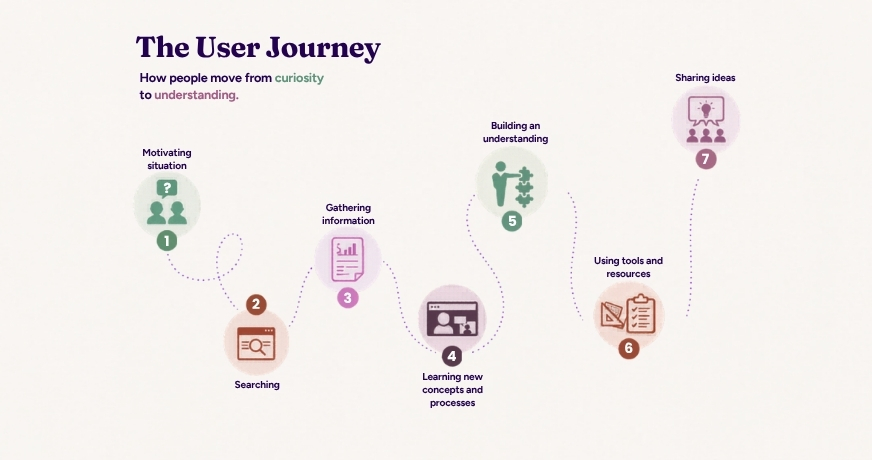
I still find myself visiting websites even when an AI has already summarized the information.
Partly because I want to verify it.
Partly because I want to understand where the information came from.
But also because some websites are interesting.
Some are thoughtful.
Some are beautiful.
They communicate something that doesn’t survive being reduced to a paragraph in a chatbot window.
I suspect this puts me in a similar category to people who still listen to an entire album from beginning to end.
The songs are available individually.
The highlights can be summarized.
The playlist can be optimized.
But sometimes the point isn’t efficiency.
Sometimes the point is experiencing the work in the form it was intended to be experienced.
Websites can be like that too.
The scent still matters
Whether someone arrives through Google, social media, a chatbot, or an AI-generated summary, they eventually have to decide what deserves their attention.
That decision happens surprisingly quickly.
A headline.
A link.
A phrase.
A visual cue.
A small signal that suggests:
“Yes. This is probably worth exploring.”
The technology changes.
Human behaviour changes more slowly.
And for as long as people are making decisions about where to spend their attention, information scent will continue to matter.