Design & Systems
The Most Important Sentence Your Organization Can’t Agree On
Every organization knows what it does. Far fewer can clearly agree on who they're helping, what challenge they're solving, and why it matters. Sometimes the most revealing strategic exercise starts with a single unfinished sentence.

One of my favourite workshop exercises is also one of the simplest.
It usually happens early in a project. I’ve been meeting with stakeholders for a few sessions. We’ve talked about their business, products, services, strategic priorities, organizational history, customer segments, competitors, budgets, regulations, technology constraints, and future plans.
Everyone is engaged. Everyone is knowledgeable.
Then I ask a simple question:
Can someone complete this sentence?
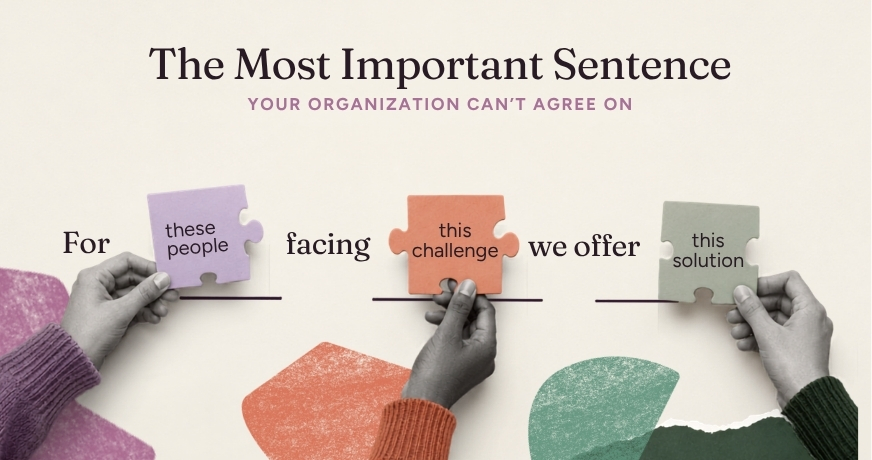
For [this group of people] having [this challenge], we offer [this solution].
The room gets quiet.
Not because people don’t know their business.
Usually, they know it incredibly well.
The challenge is that everyone answers differently.
One person starts describing products.
Another describes the organization’s mission.
Someone else talks about competitors.
A fourth person describes a customer segment nobody else has mentioned.
Every answer is reasonable.
And every answer is slightly different.
Knowing Isn’t the Same as Agreeing
Organizations often mistake familiarity for alignment.
People know the mission statement.
They know the product catalogue.
They know the services offered.
They know the history of the organization.
What they often don’t have is a shared understanding of a much simpler question:
Who are we helping, and what problem are we solving for them?
The distinction matters.
When teams lack clarity around this, it starts to show up everywhere:
- Marketing messages become inconsistent.
- Product decisions pull in different directions.
- Website content tries to speak to everyone.
- New opportunities are difficult to evaluate.
- Internal debates become harder to resolve.
Everyone is working hard.
They’re just not always working from the same map.

Why This Sentence Is So Difficult
The sentence seems simple because it forces three uncomfortable choices.
1. Who exactly are we helping?
Most organizations serve multiple audiences.
But trying to describe everyone often results in describing no one.
“Businesses.”
“Customers.”
“Users.”
“The public.”
These audiences are usually too broad to guide meaningful decisions.
Specificity creates focus.
UX Law memo:
Law of Prägnanz (Simplicity Principle)
People naturally organize information into the simplest and most meaningful interpretation possible.
Connection:
Humans naturally seek the simplest and most coherent explanation for complex information. A clear audience definition creates a mental shortcut that helps teams make consistent decisions.
Parallel Takeaway:
Users do the same thing when navigating a website. If they can’t quickly understand who something is for, they create their own interpretation—which may not match the organization’s intention.
2. What challenge are they actually experiencing?
Organizations often describe what they do instead of the problem they solve.
For example:
“We provide consulting services.”
That’s an activity.
But what challenge exists before the consulting begins?
Maybe it’s:
- Teams struggling to make decisions.
- Projects failing to gain alignment.
- Organizations investing in products without understanding user needs.
The challenge is often more important than the service itself.
3. What solution do we uniquely offer?
This is where many teams list features.
Features are important.
But features are rarely the reason people choose you.
People buy outcomes.
People choose solutions that help them make progress.
The most compelling answers focus on what changes for the customer after working with you.
UX Law memo:
Hick’s Law
The more choices people have, the longer it takes them to make a decision.
Connection:
When organizations try to serve too many audiences at once, decision-making becomes harder. Teams end up juggling multiple priorities, competing messages, and conflicting definitions of success.
Parallel Takeaway:
The same thing happens to users. The more choices, paths, and messages we present, the harder it becomes for people to decide what to do next. Clarity often comes from removing options, not adding them.
The Workshop Magic
The real value of the exercise isn’t finding the perfect sentence.
It’s listening to the conversation that follows.
People discover assumptions they didn’t realize they held.
Departments realize they are optimizing for different audiences.
Leadership learns where messaging has become diluted.
Teams uncover disagreements that have been quietly influencing decisions for years.
What starts as a simple sentence becomes a diagnostic tool.
Not for branding.
For alignment.
UX Practices memo:
Mental Models
Mental models are the assumptions and beliefs people use to understand how something works.
Connection:
The exercise works because it reveals that different stakeholders are operating from different mental models of the business.
One person thinks the organization exists to sell products.
Another sees it as delivering services.
Another focuses on the mission.
Another focuses on the customer.
Parallel Takeaway:
Many organizational disagreements aren’t disagreements at all. They’re competing mental models that have never been surfaced and discussed. Once those become visible, alignment becomes possible.
“Everyone is working hard. They’re just not always working from the same map.”
The Sentence Isn’t the Goal
I’ve seen organizations spend weeks refining positioning statements.
Sometimes that’s valuable.
But the sentence itself isn’t the destination.
The value comes from building a shared understanding that guides everyday decisions.
When a team can consistently answer:
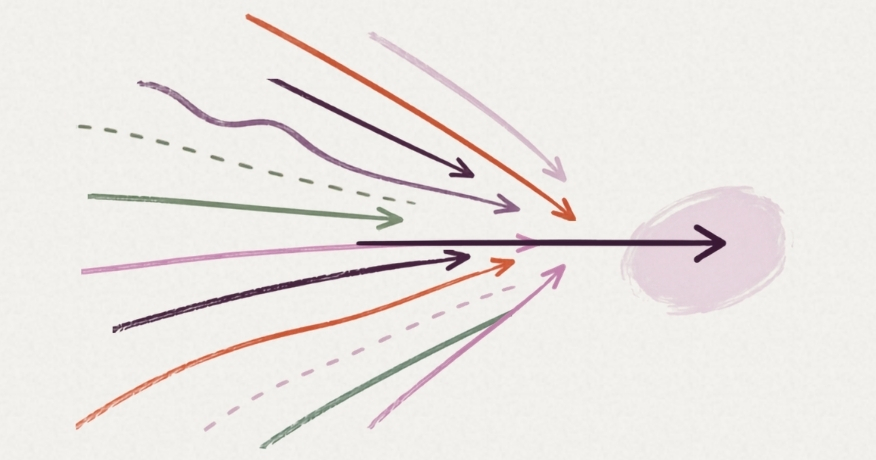
For these people, facing this challenge, we offer this solution.
Decision-making becomes easier.
Content becomes clearer.
Products become more focused.
Marketing becomes more relevant.
And perhaps most importantly, everyone starts pulling in the same direction.
That’s a lot of value from a surprisingly small sentence.
Which is probably why I still use the exercise after all these years.