History
Nellie McClung: The Woman Who Mocked the Government Into Listening
What happens when a system expects your participation but refuses to recognize your voice? Nellie McClung helped challenge some of Canada's most visible barriers to women's political participation, using wit, strategy, and public pressure—but her story also reminds us that progress is rarely as simple as we remember it.

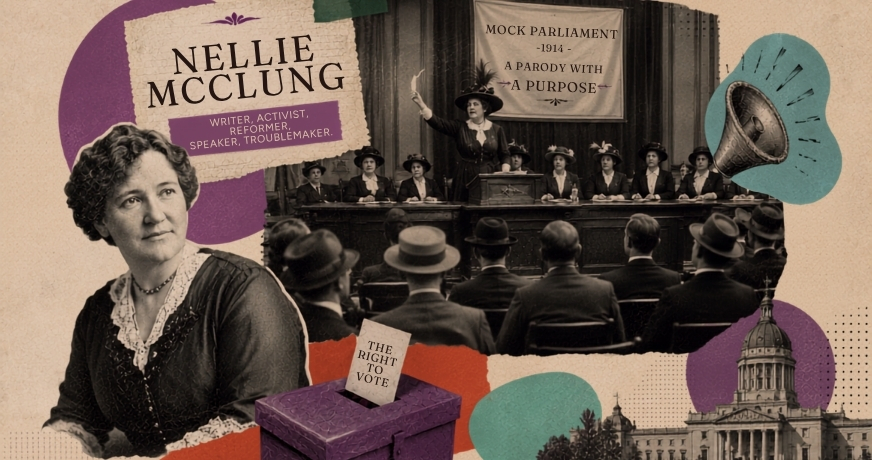
Nellie McClung is one of those historical figures whose name tends to arrive pre-packaged with a clear narrative.
Prairie feminist icon.
Suffragist.
Author.
Reformer.
One of the Famous Five.
Champion for women’s rights.
And yes—those descriptions are earned. She was influential, politically savvy, funny, and remarkably effective at making powerful people uncomfortable.
But history gets more interesting when we allow people to be fully human instead of neatly symbolic. Because Nellie McClung was both important and complicated, and those things often arrive together.
First: Who Was Nellie McClung?
Born in 1873 in Chatsworth, Ontario, Nellie Letitia Mooney grew up in Manitoba after her family moved west.
Picture rural prairie life:
Hard work. Isolation. Limited educational opportunities. A lot of dirt. An alarming amount of weather.
She became a teacher at sixteen because apparently teenage overachievement was already a thing. Later, she married Robert Wesley McClung, a pharmacist who—rather unusually for the era—supported her writing and activism.
This mattered. Because women’s public work often depended heavily on private permission. (Which is a sentence that should make all of us stare into the middle distance for a moment.)
McClung became a successful author and public speaker, writing novels and essays that tackled women’s social realities in ways people actually wanted to read. And then she turned her attention to politics. Which, at the time, was very much a boys-only clubhouse.
Women Could Pay Taxes. Just Not Vote.
Classic system design problem. Women contributed to society. Worked. Raised families. Paid taxes. Participated in community life.
But political power? Absolutely not. The argument against women voting was spectacularly flimsy. Some claimed women were too emotional. Others argued politics would somehow damage their femininity. As though voting caused spontaneous lace deterioration.
The logic was:
- Women are affected by laws.
- Women help uphold society.
- Women should absolutely follow the rules.
But should women help make those rules? No no no. That would be chaos.
Educational goblin note:
This is what we call a system benefiting from user participation without granting user agency.
UX people, you know this smell.
UX Law memo:
Jakob’s Law
“Users spend most of their time using other systems, so they expect your system to work the same way.”
Connection:
The political system expected women to behave like participating citizens—work, contribute, follow laws, support society—but denied them the familiar expectation of representation.
The mental model breaks.
If users are expected to participate fully in a system, they reasonably expect corresponding agency.
This makes the exclusion feel even more irrational.
Parallel Takeaway:
The system expected participation without permission—classic broken expectation design.
The Mock Parliament Incident (Which Was Incredible)
If Nellie McClung had lived today, she would have absolutely understood the satire of TikTok.
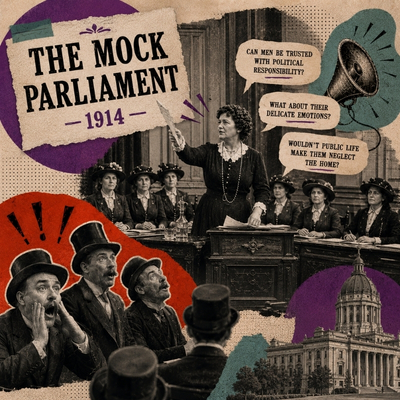
In 1914, Manitoba’s Premier Rodmond Roblin refused to support women’s suffrage. So McClung and fellow activists staged a mock parliament. A public theatrical event where the roles were reversed. Men were presented as the ones asking for the vote. Women played legislators. And McClung delivered a devastating parody of the exact patronizing arguments used against women.
Essentially:
“Can men be trusted with political responsibility?”
“What about their delicate emotions?”
“Wouldn’t public life make them neglect the home?”
It was smart because satire forces systems to hear themselves out loud. And systems often sound ridiculous when mirrored back. This was not polite lobbying. This was strategic UX friction.
And it worked.
Manitoba became the first Canadian province to grant some women the right to vote in 1916.
Progress is often built from moments like this:
persistent organizing + public pressure + making powerful people look absurd.
McClung became one of Canada’s most recognizable suffrage leaders. She later served in Alberta’s legislature. She advocated for women’s rights, labour reform, healthcare improvements, and social policy.
UX Law memo:
Von Restorff Effect
“Distinctive things are more likely to be remembered.”
Connection:
Mock parliament worked because it disrupted expectations.
A standard petition? Forgettable.
A theatrical role reversal publicly mocking lawmakers Memorable.
McClung understood attention design before UX had a name.
Enter: The Persons Case
Here’s where her name gets permanently welded into Canadian history.
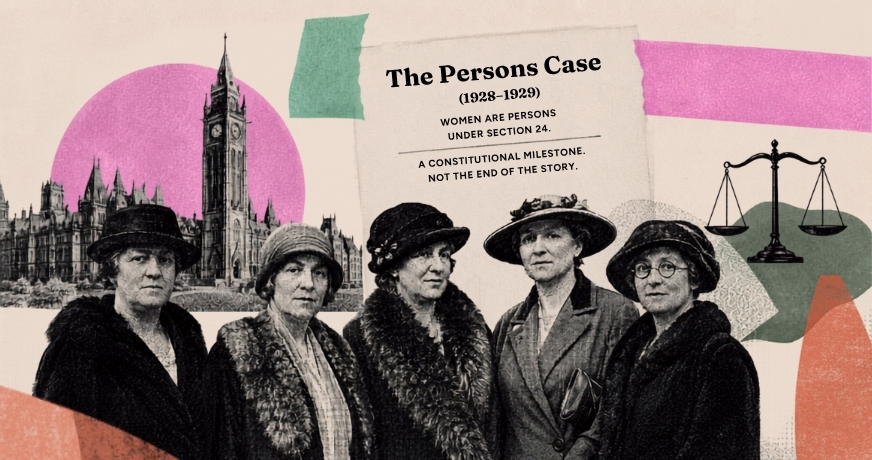
McClung was one of the Famous Five:
They challenged whether women qualified as “persons” under Section 24 of the British North America Act.
Yes. That was a real legal question. No. That sentence does not improve with context. The Supreme Court initially said no, because apparently legal personhood was being rationed.
Then in 1929, the Judicial Committee of the Privy Council overturned that decision. Women were recognized as legal persons for Senate eligibility.
And Now The Complicated Part
Nellie McClung advocated strongly for women’s equality. But not all women. Like several reformers of her era, she supported eugenic ideas.
Which means belief systems centered around controlling reproduction, often targeting disabled people, poor people, and marginalized communities under the banner of “social improvement.”
That is not a side note.That matters, a lot. Because historical progress movements are often selective. Some people get invited into personhood, others get excluded.
This does not erase her contributions. But it absolutely changes how we understand them. History is not improved by sanding off the uncomfortable parts.
UX Law memo:
Peak-End Rule
“People judge experiences largely by their peak and ending.”
Connection:
Historical memory often simplifies people based on their most famous accomplishment. Nellie gets remembered for suffrage victories. That “peak” dominates public memory. But that can obscure harmful beliefs and contradictions.
A fascinating commentary on how humans process historical narratives.
Systems Decide Who Counts
This is not just about history, this is about systems.
Who gets recognized?
Who gets believed?
Who gets represented?
Who gets designed for?
Who gets quietly excluded because “that’s just how things work”?
Sound familiar? UX is full of these questions.
A product that assumes one type of user.
A form that excludes non-standard identities.
A hiring process built around invisible privilege.
An algorithm trained on biased historical data.
Different century. Same systems smell.
Nellie McClung’s story reminds us that access rarely appears because systems become kind. It appears because someone makes exclusion visible.
UX Law memo:
Exclusion Principle
“Recognize, observe, and respect the limitations of users.”
Connection:
Historically, systems often define “normal users” far too narrowly.
The suffrage fight was fundamentally about exclusionary system design. Who was considered a valid user of democracy? Who was ignored? Who had to fight to even be acknowledged by the interface?
This parallels modern UX accessibility and inclusive design beautifully.
Why She Still Matters
Because Nellie McClung understood something crucial: Systems do not like being questioned.
Especially when the questioning is effective. Especially when it is funny. Especially when it reveals contradictions.
Her methods—storytelling, satire, public pressure, reframing power—still work because systems are still systems. But her limitations matter too.
Because progress that helps some while harming others is not the full story. And if we are serious about building better systems now—digital, legal, cultural, organizational—we need to understand both truths at once. Which is deeply inconvenient. And therefore historically accurate.
Further Wanderings in This Series
Because Nellie McClung is not the end of this story.
Other worthy reads:
- The Famous Five: complicated icons, not matching collectible figurines
- Emily Murphy and the contradictions of legal progress
- Women excluded from mainstream suffrage narratives
- What legal personhood means in the age of AI
- How modern systems still quietly decide who counts
History is never just history. It is usually a user journey with worse accessibility.